

Financial discrimination against cancer survivors
Financial discrimination is the unfair and unequal treatment of cancer survivors by banks and insurers because of their medical history.
More and more people survive cancer1
Today, more than 3 million people in Europe face a cancer diagnosis every year, and one man in three and one woman in four will develop cancer.
Over the last decades the cure rate has improved dramatically: more than 55% of cancer patients are now medically cured, and the number of survivors grows by about 3% a year thanks to early diagnosis and innovative treatments. Many cancers – such as breast cancer, childhood leukaemia and testicular cancer – now have survival rates above 80%.
Cured, yet still penalised
Cancer is no longer a death sentence. Yet many survivors face discrimination years or even decades after they were declared cured – when returning to work, and when trying to access financial services such as mortgages, loans and insurance.
Banks and insurers may refuse their services or offer different terms, often with prohibitively high premiums. This reinforces social and economic inequalities and makes it harder for survivors to live normal lives and fulfil their personal and professional aspirations.
Cancer mortality keeps falling in the EU
Mortality rates from all cancers have been declining since the late 1980s, for both men and women, and the trend is predicted to continue.
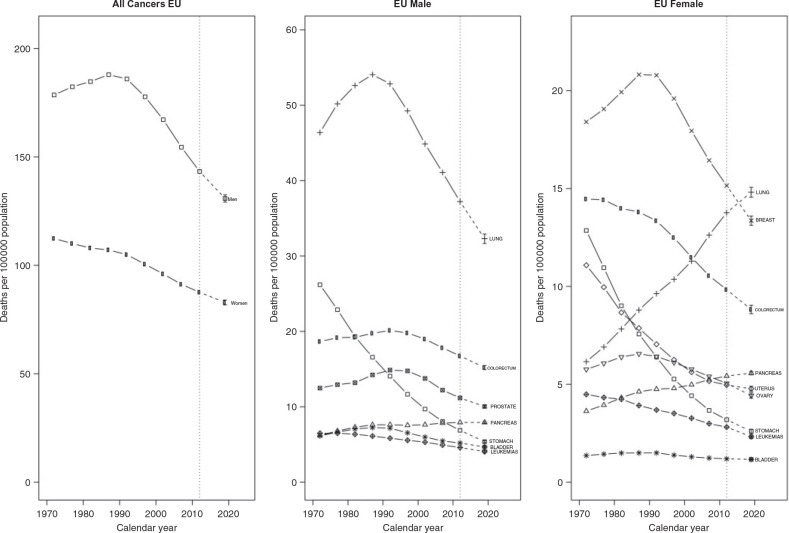
1 Source: Malvezzi M. et al., Annals of Oncology 2019; 30: 781–787. doi:10.1093/annonc/mdz051 · Read the paper on ScienceDirect

Life after cancer is a matter of equality and dignity
The Right to be Forgotten is more than health policy. Being treated like anyone else once cured is a question of fundamental rights – dignity, equality and privacy, all enshrined in the EU Charter of Fundamental Rights. On 1 October 2026, the initiative met the Women@PACE network at the Council of Europe, which is working on a motion on the Right to be Forgotten.
What is the Right to be Forgotten?
The Right to be Forgotten (RTBF) is the right of cancer survivors to resume a normal life without discrimination based on their past cancer, once they have been declared cured.
For financial services, it means that insurers and banks disregard a cancer history five years after the end of treatment, in the absence of relapse – when survivors are medically considered cured – so that their assessments reflect the applicant’s current health.
RTBF and the GDPR
Under the GDPR, the “right to be forgotten” lets individuals ask organisations to delete their personal data. To avoid confusion, this initiative speaks of “ending financial discrimination against cancer survivors”.
For cancer survivors, the RTBF does not require deleting medical data: accurate records remain essential for follow-up care and research. It requires financial institutions to disregard a past cancer after a given period.
Different rules, one principle
Eleven EU Member States have a law. In most of them, survivors no longer have to disclose a past cancer after a set period of 5, 7 or 10 years following the end of treatment, without relapse. Other countries rely on non-binding codes of conduct or agreements with insurers, and ten have no measures yet.
See national legislation